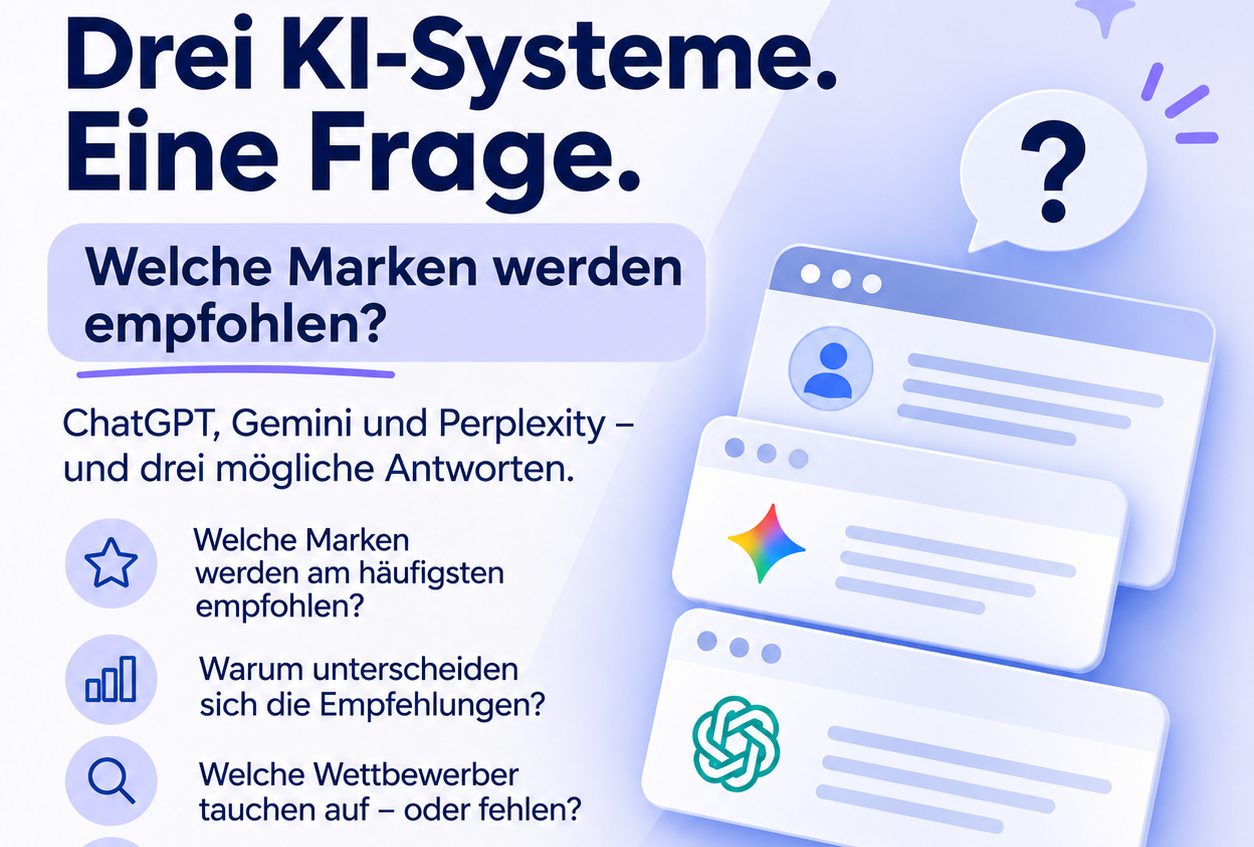
Three AI Systems, One Prompt: Which Brands Do ChatGPT, Gemini and Perplexity Recommend?
Three AI platforms, the same question – potentially three completely different competitive landscapes. What happens when ChatGPT, Gemini and Perplexity are asked to evaluate the same use case and recommend suitable tools?
Imagine you are looking for the right CRM system for a medium-sized business. You ask three AI systems the exact same question: ChatGPT, Gemini and Perplexity. The question is identical. The use case is identical. Yet the answers may be completely different. While ChatGPT might highlight certain providers, Gemini could suggest entirely different solutions. Perplexity, meanwhile, might recommend brands that do not appear in either of the other two responses. But why does this happen? And what does it mean for businesses looking to be discovered by potential customers through AI-powered search systems?
Three Platforms, Three Perspectives on the Market
ChatGPT, Gemini and Perplexity are among the best-known AI systems helping users find information, products and specific solutions. However, they differ in their technical foundations, search and information retrieval mechanisms, and the way they generate and present answers.
These differences can also influence their recommendations.
ChatGPT: Recommendations in Context
ChatGPT processes questions within their broader context and can recommend different providers depending on the model version, available features and use of search. Factors such as the wording of the prompt and the information available to the system also play a role.
Gemini: The Google Ecosystem Perspective
Gemini is closely connected to Google's ecosystem. Depending on the features used and search integration, different information sources may influence its responses. For businesses, it is particularly interesting to understand whether and how their brand gains visibility in this environment.
Perplexity: Research and Sources at the Forefront
Perplexity places a strong emphasis on information-based search and source transparency. In many responses, users can see which websites and content support a particular recommendation.
As a result, the three systems may highlight different providers – even when users submit exactly the same question.
One Prompt, Three Answers: Where Do They Differ?
A simple test can reveal these differences. All three platforms receive the exact same prompt: "We are a medium-sized company with 150 employees looking for suitable project management software. Which five tools would you recommend? Please consider ease of use, integration capabilities, data privacy and value for money." The responses can then be evaluated systematically. Four questions are particularly relevant:
1. Which brands are mentioned at all?
Which providers appear in the recommendations? Are there overlaps, or does each platform suggest a completely different selection?
2. Which brands rank highest?
A provider that consistently appears as the first recommendation holds a different position from a brand that is merely included in a longer list.
3. How does the AI justify its recommendations?
Are brands recommended because of their features, reputation, reviews or integration capabilities? Which attributes receive the most attention?
4. Which providers are missing?
This is where things get particularly interesting. Some brands may be regularly recommended by one AI platform but barely appear – or not at all – in the responses of the others.
This creates a more differentiated picture of the digital competitive landscape.
When Search Engine Visibility Doesn't Equal AI Visibility
One particularly interesting question is: Which brands does ChatGPT recommend even though they have little visibility in traditional search results? The answer can provide valuable insights into how AI-powered brand visibility works. Traditional search engine optimization and AI visibility are not the same thing. A strong Google ranking does not automatically guarantee that a brand will appear in AI-generated answers. Conversely, a provider may frequently appear in the recommendations of an AI system despite having little prominence in traditional Google search results. This does not mean that search engine optimization is becoming irrelevant. Rather, new touchpoints between businesses and potential customers are emerging. For companies, it is therefore becoming increasingly important not only to monitor their rankings in traditional search results but also to understand how AI systems perceive and position their brand.
What Can Businesses Learn from This Comparison?
Comparing ChatGPT, Gemini and Perplexity is more than just an interesting platform experiment. It can reveal valuable strategic insights.
1. Evaluate Your Own Brand Presence
Is your company mentioned at all? And if so, in response to which specific use cases?
2. Identify Your Competitors
Which brands are consistently recommended by AI systems? Are there competitors that have not previously been on your radar in traditional search engine analyses?
3. Identify Platform-Specific Differences
A brand may have strong visibility in ChatGPT while barely appearing in Gemini or Perplexity. These differences can highlight where additional optimization may be needed.
4. Develop Your Content Strategy
Analyzing AI responses and their sources can provide valuable insights into which information, content and external brand mentions may support your digital visibility.
The goal is not to optimize for a single answer. What matters is monitoring visibility across different platforms, prompts and points in time.
AI Visibility: It's Not Just About Being Found – It's About Being Recommended
The way people search for products, services and solutions is changing. Increasingly, AI systems are being used not only to find information but also to shortlist specific providers. This changes the question businesses should be asking themselves. Not just: "How well does our website rank on Google?" But also: "What role does our brand play when potential customers ask ChatGPT, Gemini or Perplexity to recommend a suitable solution?" This is exactly where AI Visibility and Generative Engine Optimization (GEO) come into play. With Vjus.AI, businesses can analyze how their brand and competitors appear in AI-generated responses. The analysis includes brand mentions, positioning, sentiment, trends and source types. Because understanding how AI systems perceive your market requires more than monitoring a single platform. Three AI Systems. One Prompt. Multiple Perspectives. The real question is not whether your brand appears in a single AI-generated answer. It's whether your brand is visible where your potential customers are looking for solutions.