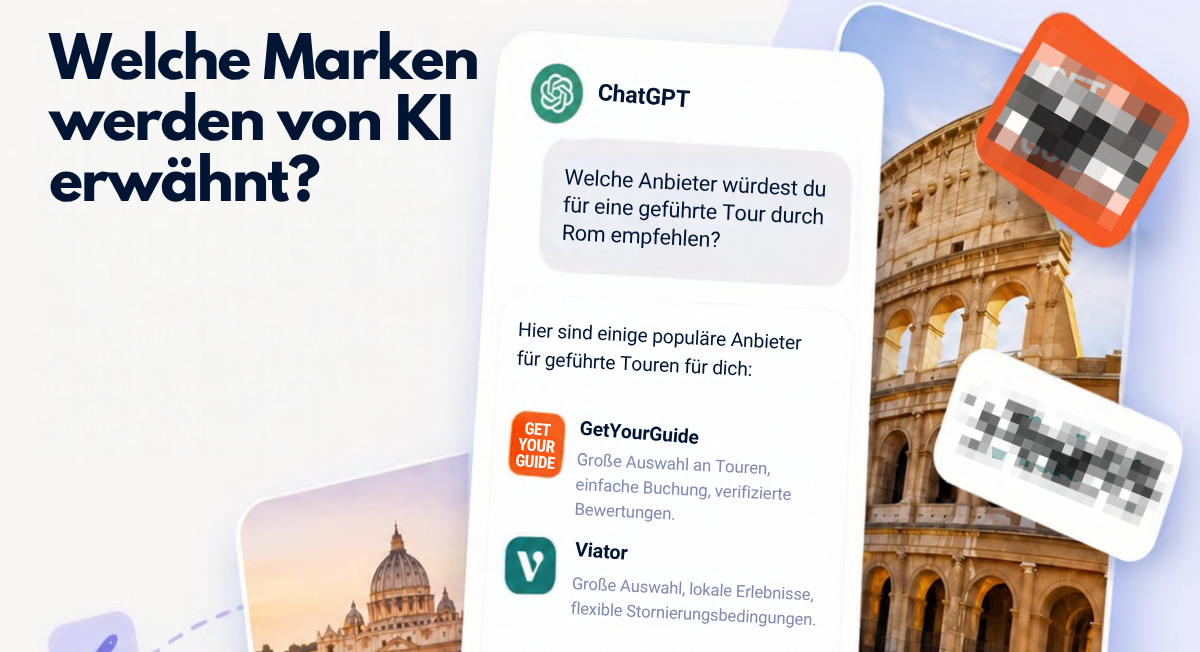
When ChatGPT acts as advertisment space: Which brands are visible - and which stay behind?
Google was yesterday – the next brand decision is made in the chat.
Today, when people search for a product, service or trip, they no longer necessarily open Google. Increasingly, the question is asked directly to ChatGPT:
“Which providers would you recommend for a guided tour in Rome?”
“Which software is suitable for a medium-sized company?”
“Where can I book a good hotel?”
This changes a central question for marketing: Will my brand even be mentioned when the decision is being prepared by an AI?
And this is where two different paths to visibility emerge: Paid Visibility and AI Visibility.
1. Being visible in ChatGPT does not automatically mean advertising
In 2026, OpenAI began rolling out advertising in ChatGPT. Companies can now place targeted ads there. These ads are clearly labeled as advertisements and remain separate from the model’s responses. For companies, this is an entirely new advertising space. But: An advertisement is not the same as a recommendation. When a user asks: “Which providers for a guided tour in Rome are available?”
and ChatGPT names Brand A, Brand B and Brand C, this is not initially a traditional advertising placement. The brands appear in the answer itself. This organic visibility is becoming increasingly relevant for marketing.
2. GetYourGuide vs. Viator: Two well-known brands – but different visibility depending on search intent
An interesting example is the comparison between GetYourGuide and Viator. An analysis of 75 AI responses across ChatGPT, Claude and Gemini examined how frequently different travel platforms were mentioned. Viator was mentioned in 59 out of 75 responses, GetYourGuide in 55 out of 75. At the same time, the analysis showed that visibility depends heavily on what the user actually wants to know. For specific booking or comparison queries, large platforms are particularly prominent. For open discovery questions such as “What should I do in Paris?” individual attractions, local providers or specialists are mentioned more frequently. This shows: AI Visibility is not a fixed position from 1–10 like on Google. A brand can be highly visible for one search intent – and barely appear for another.
3. This is where a new marketing problem emerges
Previously, a company could primarily ask: “What position do we rank at on Google?”
Today, additional questions arise:
- Is our brand mentioned by ChatGPT?
- For which search intents are we mentioned?
- Which competitors appear instead?
- Which sources does the AI use?
- Is our brand merely mentioned – or also recommended?
- Which arguments does the AI give for or against our brand?
- Does our visibility change between ChatGPT, Gemini and Perplexity?
Because the user may no longer see ten blue links at all. They receive a curated answer. And with that, the battle for visibility shifts: From “Who ranks in position 1?” to “Who becomes part of the answer at all?”
4. The interesting question is therefore not just: “Who is advertising?”
ChatGPT Ads are opening up a new paid marketing layer. But at the same time, a second layer is emerging: Paid Visibility. The brand pays to be visible as an advertisement in a relevant context. AI Visibility. The brand is mentioned, recommended or considered a relevant option by the AI system in the actual response. Both can come together. But both work according to different mechanisms. And that is exactly why classic SEO analysis will no longer be enough.
5. Those falling behind may not notice it until very late
The problem: If a brand ranks lower on Google, this can be measured relatively easily. With AI responses, the situation is more complex. The response can change: Prompt → Model → Context → Sources → Answer → Recommendation. Even a small change in search intent can cause a different competitor to appear. Example: “Which travel platforms are available for tickets in Rome?” can produce different brands than: “I’m in Rome for three days and want the most authentic experiences away from the typical tourist attractions.” For brands, this means: AI Visibility must be analyzed at the prompt level. Not just at the brand level.
6. This is exactly where AI Visibility comes in
Anyone who wants to remain visible in the new search landscape should therefore not only measure whether their own website is being found.
But:What does AI say about my brand? And even more importantly: What does it say about my brand compared to my competitors?
These questions can be systematically tracked:
- Mention Rate
- Position within the response
- Sentiment
- Mentioned strengths and weaknesses
- Competitors
- Sources used
- Search intent
- Changes over time
Because if ChatGPT is already influencing a potential customer during their research, the customer journey may begin before the user even clicks on a website.
The new SEO question is therefore no longer